Showing posts with label IP. Show all posts

Wednesday, 27 September 2017

IP and Food

Gary Townley


Jane Lambert

Tomorrow, between 10:00 and 13:30, Gary Townley, business and events manager at the Intellectual Property Office will talk about IP for the food and drink industry at Northampton Central Library. You can register for the event here.

I don't know what Gary will be talking about but there is a lot of IP connected with food and drink:

As I reported in Thought for Food 26 Sept 2017 NIPC London Gary has already spent the last two days at the Takeaway & Restaurant Innovation 2017 Expo.

IP in food production, preparation, marketing and distribution is a subject of which I do have had a lot of experience having been in some important cases and having advised and represented some rising stars in the industry. If you are involved in that sector I should be glad to talk to you. Call +44 (0)20 7404 5252 during office hours or send me a message through my contact form.

Saturday, 5 August 2017

Nottingham's FinTech Accelerator

Source Wikipedia


In a speech on the Financial Conduct Authority's regional FinTech engagement which he delivered at the Leeds Digital Festival on 27 April 2017, Christopher Woolard, Executive Director of Strategy and Competition at the FCA said that although most of the initial development work on fintech up to now had taken place in London there was real potential beyond London for a further wave of innovation. He singled out the Leeds-Manchester and the Edinburgh-Glasgow corridors as emerging hubs but failed to mention Nottingham which was the location for one of the first if not the first fintech accelerator outside the capital.

On 17 May 2016, the British subsidiary of the US consumer finance company, Capital One, in collaboration with L Marks Ltd, announced the Capital One Growth Labs. That was a 10-week accelerator programme for up to 6 early-stage start-up and high-growth companies. The successful companies were offered direct access to Capital One's software engineering department at its Nottingham head office. That provided an opportunity to refine and test their products as well as to receive close mentor support from experts from the company and the wider tech industry. While they were in Nottingham they were also offered a series of workshops and talks on branding, business development, law and marketing, At the end of the programme they were to be offered opportunities to present their products and bid for investment.

Applications were sought in the following categories:
  • Unstructured data insight
  • Security and fraud prevention
  • Money management tools
  • Enabling healthy financial habits
  • Agent technologies
  • Open category.
The open category was available to any startup with a potential offering to Capital One such as payment solutions, tracking, new lines of business or a physical/digital bridge. 

Applications in writing were requested by 12 June 2016. Capital One and L Marks invited 19 businesses to Nottingham to pitch for the 6 places to a panel of Capital One's senior managers and outside experts on 6 July 2016. 

In an announcement dated 19 July 2016, Capital One said that it had chosen the following 5 companies to take part in the accelerator:
  • Credit Kudos of London which had developed a method of credit scoring based on the customer's financial history presented by Credit Kudos's co-founder, Freddy Kelly, n Simple Fair and Accessible Credit which appeared on Capital One's website on 25 Aug 2016;
  • Multisense, a Dutch company which had developed a mobile authentication system using face, voice and fingerprint recognition;
  • Pariti Technologies Ltd., another London business which had developed a mobile app to enable users to control their income and expenditure by connecting to all their bank and credit card accounts (see How Pariti works);
  • Warwick Analytics, a spin-off from the Univesity of Warwick's computer science department, which had developed automated predictive analytics that can remove the 80% of time data scientists need to organise and process data prior to analysis; and
  • WealRo, a mobile app that uses AI technology and machine learning to help users to budget where savings can be made.
I have not yet found any information about what happened on the programme, whether any of the companies found investment or whether Capital One bought any of those products or invested in any of those businesses. I can report that I have visited all the finalists' websites and they all seem to be thriving. I have not found any evidence that indicates that the accelerator has been repeated or that a second cohort will be chosen. There are however other financial institutions in Nottingham and I see that the Nottingham Building Society is investing heavily in fintech (see The Nottingham announces Major Investment in New Digital Technology in Fintech Finance).

The inclusion of law in the programme of talks and workshops for the Capital One accelerator, As I said in my FinTech introduction and overview,  I see three potential legal issues with any fintech project:
  • data protection and privacy particularly with the implementation of the General Data Protection Regulation next May;
  • intellectual property; and
  • regulatory issues.
Data protection and privacy will be particularly important for all companies' products, particularly Credit Kudon which collects data on and evaluates data subjects' credit scores. As for regulation, I refer each of the British companies to the FCA's regulatory sandbox if an in so as they are not already aware of it.

Should anyone need amplification or clarification of any point in this article, call me on +44 (0)20 7404 5252 during office hours or send me a message through my contact form.

Further Reading

Date
Author
Title
Publication
03 Aug 2017
Jane Lambert
NIPC Law
03 Aug 2017
Jane Lambert
NIPC Law
27 Apr 2017
Jane Lambert
NIPC Law

Thursday, 28 April 2016

Why Every Business Owner in the East Midlands Needs to Know Something about IP

IP can make more trouble than the Lincoln imp (see The Legend Visit Lincoln)
Author Hongking
Source Wikipedia

Reproduction licensed by the author


Jane Lambert

For the last twenty years I and countless others have been telling business owners in this region the positive case for learning about intellectual property ("IP"). There is a very powerful one. It can help businesses to establish themselves in a market by shielding them from competition. That is because the bundle of laws that we refer to as IP grants those who devise new products or processes monopolies of their inventions known as patents and a right to those who compose music or create games to prevent others from broadcasting, performing, publishing or otherwise exploiting their work known as copyright.

Too often my presentations in this vein are met with polite applause and the occasional question or discussion after the talk which probably explains why the UK, the country of Newton, Faraday, Watt and the first industrial revolution has trailed consistently not just Germany and France with similar populations and GDP in the number of European patent applications but even the Netherlands with one third of our population and Switzerland with an eighth.

So now I am going to try a different tack. One of fear. Those same monopolies and exclusive rights that can leverage your company's investment in branding, design, technology and creative output could threaten the very existence of your company and cost you plenty?

"How so?" you ask.
Well those same IP laws can grant monopolies to your competitors and impose restrictions on what you can make or sell and the name or style under which you carry on business that can be infringed quite inadvertently. If you are found to have infringed someone's IP right you could be injuncted (ordered by the court to do or refrain from doing something on pain of imprisonment for disobedience) and made to pay damages (compensation) or account for and surrender any profits that you have made from your wrongdoing and contribute substantially to the other side's legal fees and other costs. Some IP infringements are also criminal offences so in an extreme case you could be prosecuted and even fined or sent to prison if convicted.

"I understand that I could get into trouble if I copied someone's product or brand name," you say, "but all our research work, design and branding is done in-house and we are very careful not to copy anyone else's."
Unfortunately, that may not be enough for a monopoly can be infringed quite unintentionally. You may import a product made quite lawfully in China or some other country which falls within the claims of a patent granted by the Intellectual Property Office in Newport or the European Patent Office in Munich. If you did not know of the patent you should have done because nearly every British and European patent and patent application is published on the Espacenet, Google and other patent databases and all you have to do is look.

Easier said than done, of course, because patent searching is a skill that takes time to learn but there are plenty of people who will help you including Ged Doonan of Leeds Business and IP Centre on 0113 247 8266. You should also keep your ear to the ground and keep abreast of the technical literature.

Patents are not the only monopoly rights of which you should be aware. Businesses that register names and other words or logos as trade marks in relation to specified goods or services have the exclusive right to use their marks in relation to such goods and may sue anyone who used the same or similar sign in relation to the same or similar goods or services. The fact that you not have known of the registration is no defence. You should have made a proper search. If the registration or application would have shown up on a search you have only yourself to blame if you are injuncted and mulcted in damages and costs by the High Court.

There is also a registration system for designs in the UK and across the EU. Registration gives the person who registered the design "the exclusive right to use the design and any design which does not produce on the informed user a different overall impression" in "making, offering, putting on the market, importing, exporting or using of a product in which the design is incorporated or to which it is applied" or "stocking such a product for those purposes." It is up to you to check whether the product that you make or sell falls within someone else's design registration.  Again, the Leeds Business and IP Centre should be able to help.

You should review the patent, trade mark or design registers regularly and preferably use a "watch service" (a service that monitors patent, trade mark and registered design applications and warns of any that may may affect their client). Yet again, Ged may be able to help.

You will probably find that any legal indemnity insurance that you may have taken out specifically excludes intellectual property claims but you can get such cover from specialist brokers such as Sybaris Legal and IP or Safeguard IP.

There may be grounds upon which you can retaliate. Sometimes it is possible to apply for the revocation of a patent or trade mark or seek the invalidation of a trade mark or design registration either in the IPO or to counterclaim for such relief in any infringement proceedings that may be lunched against you. It is also actionable to threaten patent, trade mark or registered design infringement proceedings without justification.

So where to get more information about IP? Well the IP, the Chartered Institute of Patent Attorneys and the World Intellectual Property Organization has made some useful animations which I discussed in Animated Advice on 18 March 2016 4-5 IP. The only Business and IP Centre in the East Midlands is Northampton Central Library (see Northampton Business and IP Centre 28 July 2015 and there is nothing to stop your consulting the resources in Birmingham, Hull and Sheffield.

If you think that you may have a problem in relation to someone else's IP rights or you simply want to discuss this article, give me a ring during office hours on 020 7404 5252 or message me through my contact form. Over the next few months I hold on-line and person to person seminars on this topic around the region in conjunction with local stakeholders.  If you are interested in coming do let me know.

Monday, 31 August 2015

Intellectual Property and the Footwear and Textile Industries

Nottingham Lace Market
Author Allan Murray-Rust
Source Wikipedia
Creative Commons Licence


Jane Lambert


According to the East Midlands Textile Association ("Emtex") the East Midlands has the highest concentration of clothing and textile companies in the UK. Nottingham lace, Leicester knitwear, Northampton shoes have an enormous international reputation founded on branding, craftsmanship and design.

These intellectual assets that are protected by registered trade marks, registered designs and other intellectual property laws and on the 10 Sept and 7 Oct 2915 I shall explore such legal protection in a seminar for MBL entitled Intellectual Property and the Fashion Industry.  In this seminar I will cover the following topics:
  • What sort of IP protection does my employer or client require for his business and where?
  • What provisions should I insert in my employer or client's licence or manufacturing agreement?
  • What should I do if I find copies or lookalikes of my products in competitors' shops?
  • What's Hot? The implementation of s.74 of the Enterprise and Regulatory Reform Act 2013 - John Kaldor v Lee Ann/Specsavers vASDA/Thomas Pink v Victoria's Secrets
  • IP basics; terminology, intellectual assets (brands, designs, technology and works of art and literature), intellectual property (trade marks, registered designs and unregistered design rights, patents, trade marks, law of confidence and action for passing off), institutions (Intellectual Property Office, Office for Harmonization in the Internal Market, European Patent Office, World Intellectual Property Organization), Sources of law (treaties and conventions (TRIPs, Paris and Berne), EU legislation, statutes), enforcement. remedies, licensing
  • Advising the designer: types of design, aesthetic design, functional design, design registration and equivalent regimes, TRIPS, Paris and Rome Conventions, Designs Directive, Community Design Regulation, Copyright, Designs and Patents Act 1988, Registered Designs Act 1949, licensing, enforcement
  • Advising the manufacturer; patents, trade marks, designs, licensing, cabbage, summary of laws in China, Egypt, India, Indonesia, Morocco, Pakistan, Thailand and Turkey
  • Advising the retailer: trade marks, passing off, searches, agreements with designers and manufacturers
  • Dispute resolution: High Court, Patent Court, IPEC (multi track and small claims), IPO examiners' opinions, appointed person
  • IP strategy: identifying appropriate rights for particular jurisdictions, selecting and instructing foreign attorneys, watch services.
My seminar in London will take place on 10 Sept 2015 and my seminar in Leeds on 7 Oct 2015. Both will start at 09:30 and end at 17:15 and will earn 6 hours CPD. The standard cost is £480 but there will discounts for season ticket and smart plan subscribers. Register on-line or call  MBL on 0161 793 0984.

Tuesday, 3 March 2015

So maybe Grantham really is interested in IP Law

Rabbit food produced by Henry Bell of
Granthan

Jane Lambert

Last September I tried to run a seminar on IP law as part of the Gravity Fields science and arts festival. To promote the seminar I wrote What has intellectual property got to do with Grantham? 4 Sept 2015 and an introduction to patent law as a Socratic dialogue in The Beehive pub. Try as I might I just couldn't raise any interest in IP and I had to cancel the seminar.

But a case that came before Mr Justice Arnold a few weeks ago shows that that there is at least one Grantham business that is interested in IP for it has contributed to the development of trade mark law. In Supreme Petfoods Ltd v Henry Bell & Co (Grantham) Ltd [2015] EWHC 256 (Ch) (12 Feb 2015) the Grantham pet food producer Henry Ball & Co. successfully resisted a claim by Ipswich based Supreme Petfoods Ltd. for trade infringement and passing off.  It is a very long, and unless you are a trade mark geek, difficult to follow, judgment but I have analysed it in my case note Trade Marks and Passing Off: Supreme Petfoods Ltd v Henry Bell & Co (Grantham) Ltd. 28 Feb 2915 which appears in my NIPC Law blog.

Basically, Supreme Petfoods objected to the packaging of Henry Ball's products because they had registered the word SUPREME as a word mark and various signs that incorporated the word SUPREME as device marks for various types of animals food.  The judge characterized their claim as an attempt "to monopolise use of the word SUPREME as a trade mark for animal food." He didn't let them do it.  He invalidated several of Supreme Petfoods' registrations except for small animal foods and held that Henry Ball did not infringe the trade marks that remained.

This is an important case for several reasons.

First, Mr Justice Arnold stressed that EU and hence UK trade mark law must be consistent with an annexe to the agreement that established the World Trade Organization called TRIPS (The Agreement on Trade-Related Aspects of Intellectual Property Rights) wherever possible. That is because it is an international agreement which HM government and the governments of all the other member states of the EU signed with most of the rest of the world's governments and pacta sunt servanda (promises need to be kept).

Secondly, the judge explored what makes a trade mark distinctive. It can be inherently distinctive simply because of its uniqueness or in the case of common English words like SUPREME it can acquire distinctiveness through making lots of sales and clever marketing. His lordship focussed on acquired distinctiveness.

Thirdly, the judge laid down six conditions that must be satisfied for a claim under s.10 (1) of the Trade Marks Act 1994 and art 9 (1) (a) of the  Community Trade Mark Regulation which he claimed to have been established by a long line of cases in the Court of Justice of the European Union. Though Mr Justice Arnold made no claim as to originality in respect of this analysis I think he is way too modest because I have never seen them anywhere else.  In Enterprise Holdings, Inc v Europcar Group UK Ltd and another [2015] EWHC 17 (Ch) (13 Jan 2015) which he decided a month earlier he made a similar analysis of the case law for claims under s.10 (2) and (3) of the Act or arts 9 (1) (b) and (c) of the Regulation. When read together Europcar and Supreme set out almost everything you need to know about trade mark law.

Fourthly, his lordship analysed in detail the last two of the six conditions for a successful suit under s.10 (1) or art 9 (1) (a), namely the use of the defendant's sign
"(v) .... must be in relation to goods or services which are identical to those for which the trade mark is registered; and
(vi) it must affect, or be liable to affect, one of the functions of the trade mark."
Most of Mr Justice Arnold's judgment was on those two points. He decided them in the defendant's favour at paragraph [165] because
"Henry Bell's use of the sign SUPREME would be understood by the average consumer as being purely descriptive."
In other words Henry Bell's packaging suggested that its food was of supreme quality and not that it came from Supreme Petfoods Ltd.

Fifthly, he made a very pithy comparison of mark and sign and specified goods and goods in use at paragraph [185] before throwing out the claim under s.10 (2) and art 9 (1) (b).

Sixthly, he did the same for the claim under s.10 (3) and art 9 (1) (c).

So this is a great case if you are a litigation solicitor in Lincoln or commercial lawyer in Spalding and your client walks into your office with a trade mark problem. Instead of thinking of learning curves and what they will do to your profits - or worse what patent counsel will do to those profits - you should read this case with my analyses and all will become clear I promise you.

Now I know this has nothing to do with intellectual property law but I am a ballet nut and the only other person I know who is crazier about ballet than me is called Michelle and she also comes from Linconshire. Your great county, oh Yellow Bellies, happens to host one of the best little dance companies in England called Chantry Dance Company which you really should support with your patronage. Last year they ran a workshop at the Drill Hall in Lincoln.  Here is the video of the show that put together with the help of two folks from Yorkshire and two from Coventry.  Can you identify the dancer stage right in the second row?

'Dream Dance' workshop from Rae Piper on Vimeo.

If you can I will buy you a pint next time we are both in The Beehive. If you want to discuss Supreme Petfoods and Bell or trade mark law in general give me a ring on 020 7404 5252 during normal office hours or message me through my contact form. Hasta luego amigos.

Thursday, 29 January 2015

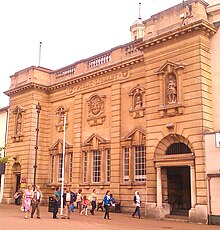
Northamptonshire Central Library joins the PatLib Network

Northamptonshire Central Library
Photo Wikipedia


The PatLib network is a European network of libraries providing information on patents and other intellectual property rights to their local communities. I have written extensively about the PatLib network and you will find basic information and links to my other articles in PatLib Libraries in the UK 29 Jan 2015 Inventors Club blog, There are 15 PatLib libraries in the UK and Northamptonshire Central Library is one of the latest to join the network.

The Library offers a variety of business support and IP services in association with Northamptonshire Enterprise Partnership. These include:
  • information on IP, copies of IPO and EPO literature
  • enquiry service by appointment
  • advice on searching
  • free public access to internet, IP information resources, databases
  • commissioned IP searches
  • bespoke training sessions
  • business information advice sessions
  • referrals to other advice/service providers
  • workshops and seminars.
More information about these and other services can be obtained from the Northamptonshire Enterprise Hub Facebook page.

Thursday, 4 September 2014

What has intellectual property got to do with Grantham?


Everything. 

There are a lot of businesses in Grantham and they all have signs that distinguish them from their competitors. Most of those signs consists of names or logos but the sign for the The Beehive inn in Castlegate is actually a swarm of bees. It is those bees that distinguish The Beehive in the minds of its customers from all other pubs in Grantham and indeed the rest of the world.  The Beehive's regulars would no doubt find their way to the pub if the bees went away but those such as I who are not quite so familiar with Castlegate look out for the hive. It is that hive that draws us to that pub and once inside the pub we spend our money. 

The tendency of customers to frequent a business is called goodwill.  At least some of that goodwill is associated with the hive. The hive is therefore an asset in that it generates revenue for the pub. We class it as an intellectual asset because it is the product of the mind rather than a plot of land or item of machinery. The rights to those assets are known as intellectual property.

An example of how the law protects a sign arose in Bocacina Ltd v Boca Cafes Ltd. and Others [2013] EWHC 3090 (IPEC). In that case the claimant owned a successful and trendy bar, restaurant and gallery in Bristol known as Bocabar which was sometimes abbreviated to Boca.  Its annual turnover was around £1 million per year. It had a website under the domain name bocabar.co.uk and it advertised in the local press and through flyers and point of sale literature. The establishment had been featured in several guides to Bristol and restaurant reviews.

The defendants set up an eatery known as Boca Bistro CafĂ© which offered similar food and entertainment some three miles away. They registered BOCA BISTRO CAFE as a trade mark in respect of cafeteria and restaurant services in class 43 and the domain name bocacafes.co.uk which showed up in  close proximity to the claimant's on internet searches.

The claimant sued the defendant in the Intellectual Property Enterprise Court which specializes in resolving intellectual property disputes between small and medium enterprises. The claimant claimed an order from the court known as an injunction to stop the defendants from running a business called Boca, Bocabar or anything similar. An injunction comes with a stern warning from the judge that anyone breaching the order will be fined, sent to prison or punished in some other way. The claimant also claimed orders invalidating the defendant's trade mark and cancelling its domain name registrations and damages or compensation for any loss or damage it had suffered.

In order to win the claimant has to prove that:
  1. its goods or services had acquired a goodwill or reputation in the market and are known by some distinguishing feature;
  2. there had been a misrepresentation by the defendant (whether or not intentional) leading or likely to lead the public to believe that goods or services offered by the defendant are goods or services of the claimant; and
  3. the claimant had suffered to was likely to suffer damage as a result of the erroneous belief engendered by the defendant's misrepresentation.
The claimant succeeded. The judge held that the Bocabar had acquired a goodwill or reputation in Bristol by reference to its name Bocabar and abbreviations such as Boca. By calling their establishment Boca Bistro Bar and setting up a website under the domain name bocacafes.co.uk the defendants had misrepresented a connection with the Bocabar. They had thereby attracted business for their eatery from customers who would otherwise have gone to the Bocabar.

Could such a case occur in Grantham? Sure it could. Not with The Beehive, of course, but perhaps with other businesses. The rules that I mentioned above are not confined to firms in the catering trade but apply to all industries.

Now if you want to learn more about the laws that stop folk naming their businesses or adopting other signs that are likely to be confused with the signs used by other businesses you will just have to come to my talk at Grantham College on the 26 September 2014 at 14:00 (see "Our contribution to Grantham's Gravity Fields Science Festival: IP Workshop and Clinic" 3 Sept 2014). If you have a specific issue of passing off you can have a free 30 minute consultation with me afterwards.  If you want to register a trade mark or indeed oppose or invalidate someone else's registration you can have a word with Mr Keith Loven of LovenIP in Lincoln.  Of course, if you have a pressing problem you don't have to wait quite that long. You can call me on 020 7404 5252 during office hours or message me through my contact form any time.

I look forward to seeing you on the 26 Sept.